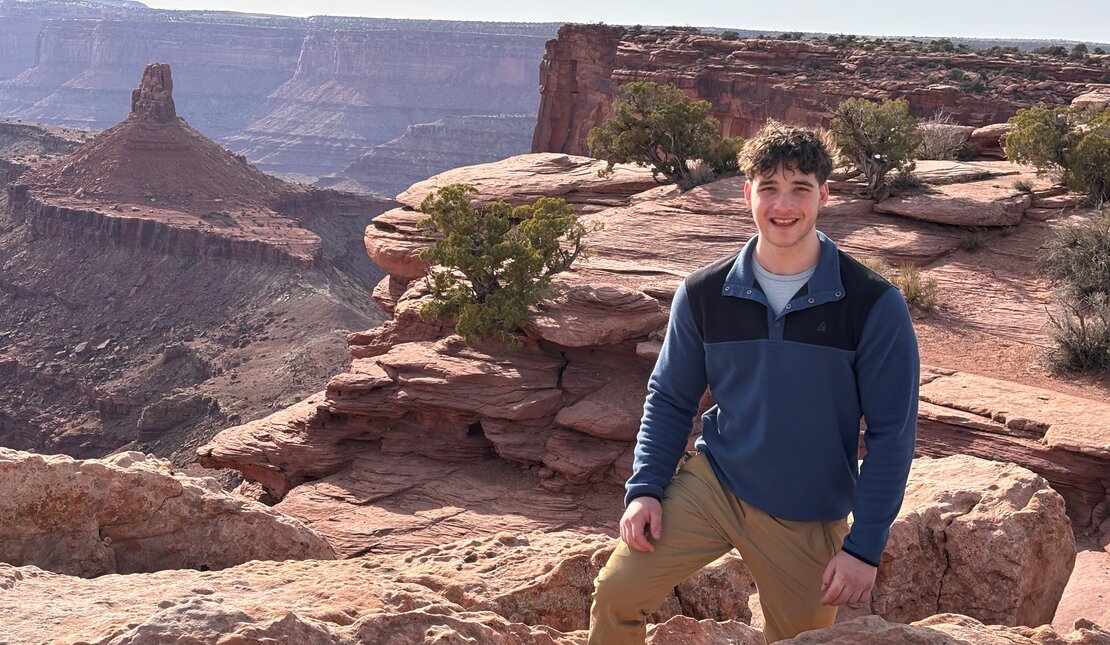
Difference Maker of the Year Gregory Perri is Making the Stars Accessible to All

Astronomy has always been a part of Gregory Perri's life. His father completed his undergraduate degree in astronomy, and he always learned about space and loved going to see meteor showers. When his family friend, who had a vision disability, talked to Gregory about astronomy, Gregory was inspired to think about ways to make astronomy more accessible and share the joy that he himself gets from learning about astronomy.
"Astronomy is considered a visual science," Gregory said. "But there are folks out there who might have a visual disability and would love to learn about it. It all started with me wanting to include all my friends to go look at the stars."
Gregory decided to reach out to CNIB with the idea of an astronomy club that focused on making the science more accessible. After consulting with CNIB and others with lived experience, the club began.
Gregory was one of the recipients of the Rick Hansen Foundation School Program (RHFSP) Difference Maker of the Year Award in 2026.
The RHFSP Difference Maker of the Year Award celebrates youth ages 5-18 whose accessibility projects go above and beyond to make their schools and communities more inclusive by creating more awareness and removing barriers for people with disabilities.
"Receiving this award is an honour. It shows that people care about the work we are doing." Gregory explained. "I hope to inspire others and my community to improve accessibility in their own spaces, and to look at all the work all the recipients are doing."
Creating an Accessible Astronomy Club
The club runs through online sessions on zoom monthly and is open to folks of any age across Canada. In each session, participants cover a major astronomy topic and a guest speaker to discuss an astronomy topic. The content is covered through multisensory exploration, including verbal descriptions, sonification, and tactile experiments. Gregory also created a tactile, portable star map that allows blind users to understand the constellations through touch.
"We use strings and paper to help abstract the large concepts of astronomy," Gregory explained. "While it is tactile and helps those with a vision disability, it also helps people without a disability understand these concepts that can be quite complicated."
Building a Community
In building the club, Gregory is most proud of the community that they have been able to build.
"Every time we have our sessions, the same people come back." He explained. "They are really curious and enjoy the work that we're doing."
For Gregory, it's also been a big learning experience for him and has challenged his assumptions about disability. The group is very unique and diverse, and the range of lived experiences has helped Gregory improve the club and learn more about astronomy.
Moving forward, Gregory is excited to keep the club going. He also has plans to do a regional meetup where the community can meet in person. Gregory is also working on a 3D printed star map that he wants to use in the program once it is ready.
"I want more people to be able to experience astronomy. Creating a specific program with aids that allow everyone to participate can reinforce the value of equity and accessibility."