Bringing the Man In Motion to a New Generation

On February 26, 2023, Lorna Schultz Nicholson raised the idea of writing a children’s book about the Man In Motion World Tour with Rick Hansen.
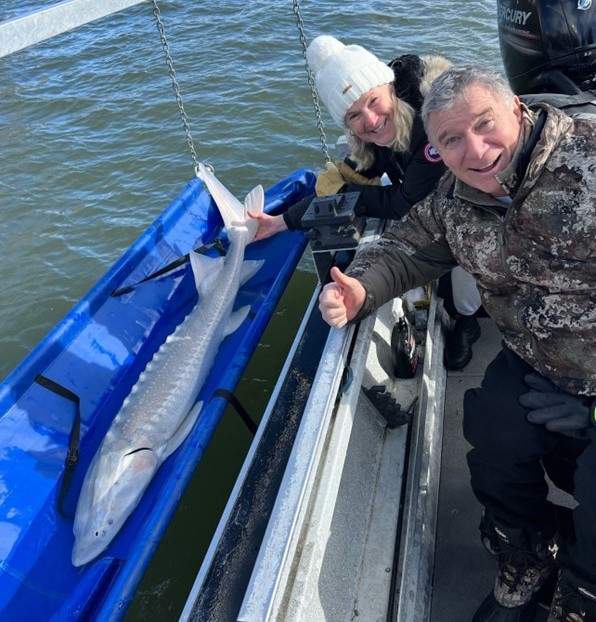
The timing was memorable. A late winter storm had brought heavy snow that wreaked havoc on traffic in the Lower Mainland the night before. Temperatures hovered below zero and the Fraser River, where Lorna spent much of the day, had run so cold in previous weeks that blocks of ice the size of small cars had formed upriver.
It was, by every practical measure, not a great day to be out tagging sturgeon.
There were only four passengers on board the ‘Everyone Everywhere’, the accessible vessel used in Rick Hansen Foundation’s Accessible Outdoors Program. They were Rick; Lorna, visiting from Penticton; her friend from Edmonton, whose connection to Rick had grown through years of fishing trips and community work; and Tony Nootebos, a local angling guide and sturgeon conservation expert.
“Snow had piled up on the docks,” Lorna remembered. “I thought for sure that the outing would have been canceled.”
But, as any writer will tell you, good stories often begin in imperfect conditions.

From One Idea to Another
The idea of a children’s book about Rick had been circling around Lorna’s head for a while, though in a different form. She had imagined a book called ‘The Cable Car Boys,’ centered around the friendship between Rick and Terry Fox, who played together on the wheelchair basketball team of the same name.
The idea gradually shifted. Terry’s story already occupied enormous space in the Canadian imagination. Rick’s story felt quieter, particularly for children. The Man In Motion World Tour, now 40 years in the past, existed mostly in photographs, memories, and television clips, and Lorna felt that there remained something oddly unfinished about its place in children’s literature.
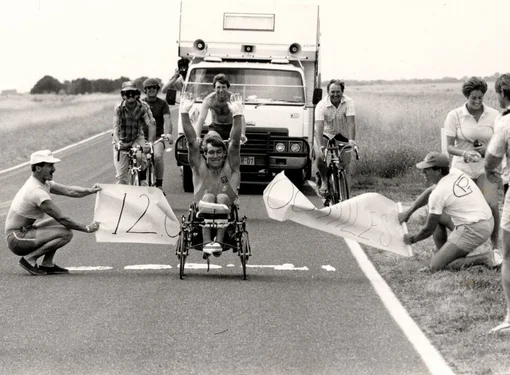
That absence matters because the Tour now occupies a curious historical space. It is recent enough that many adults remember it vividly and distant enough that children encounter it almost like an expedition narrative from another age. It’s a world that feels almost unimaginable now: no cell phones, only paper maps and pay phones, over the two years, two months, and two days of the Tour.
Children’s picture books are deceptive objects. They sit lightly in the hand and are typically short. The language appears to be simple. People who would never casually announce that they could write a novel will take one look at a picture book and assume they could produce one before lunch.
Lorna, with more than 50 books to her name – many of them for young audiences – has spent enough years as a writer to know better.
The finished children’s book ‘The Man In Motion’ contains roughly 1,500 words. These words carry the catastrophic accident that led to the Tour, the exhaustion and perseverance, and the shifting perceptions of people with disabilities that followed. All of it is written in a way a child can hold, understand, and carry with them.
“Everybody thinks, oh, the picture book’s super easy,” Lorna said. “The amount of work going in to make it look like it's simple is way more than what you can imagine. I think a lot of people think that writing for children is a lot easier than writing for adults when, actually, I find it far more difficult because you not only have to write in a child’s voice, but you also have to speak to them too.”
That challenge became even greater when, many drafts later, she and her editor delivered what they believed was the finished manuscript to OwlKids Books, only to have to regroup and start over.
The first version leaned heavily on geography, with maps spread across its pages and regions serving as anchors for a story that took readers from Canada to Asia to Europe, then back home again. But the publisher said it felt a bit flat.
Lorna and her editor were devastated. They’d worked so hard. But the problem, they realized, was that the book portrayed motion without emotion. So, Lorna went back to Rick.
“I told him that we needed to talk about how you felt at all these different moments of time. And… if there were any times when he wanted to quit. That’s what was missing, the highs and the lows.”
Those answers changed the book, and the maps no longer drove the narrative. In their place, came uncertainty, determination, fatigue, triumph, and all the invisible work that exists between one kilometer and the next.
The ‘Man In Motion’ wasn’t Lorna’s first book, so as difficult as it was to start from scratch, quitting was not an option. Plus, she pointed out, there was inspiration in the symmetry of a book about persistence demanding persistence from its writer.
“I have to say that Rick’s story helped a lot because I thought, ‘Well, goodness gracious Lorna, if Rick can go for two years, two months, and two days around the world, I think you can rewrite a second draft,’” she said. “I mean, look at what this guy did!”
Meanwhile, life kept arriving in ordinary ways. Nicholson’s first grandchild was born while she was immersed in the project. Suddenly accessibility stopped being an idea attached to policy language and became something experienced physically. During family visits to Toronto, she found herself pushing a stroller through Toronto transit stations, searching for elevators, rerouting constantly.
“I was thinking, gosh, people in wheelchairs have to do this every day.”
Even playgrounds looked different. For instance, Lorna now understood how wood chips, something many people barely notice, can be barriers for kids and parents using mobility devices.
“I would have been one of the ones who thought, ‘Oh, wood chips.’ And now I think, ‘Oh, wood chips. They make no sense.’”
This is one of the truths of accessibility, that it often comes into sharp focus when its absence turns ordinary moments into barriers.
Always In Motion
That bitterly cold day on the Fraser River was a few years ago now, before the manuscript for the book existed, before illustrator Emma Fitzgerald brought Rick’s journey to life on the page, and before the 40th anniversary of the Man In Motion World Tour.
Lorna’s ‘Man In Motion’ children’s book now carries that story to a new generation of readers. And it is fitting that it all began on a day of snow and freezing temperatures. Because the day brought the kind of less-than-ideal conditions that, in Rick Hansen’s world, was never reason enough to stop moving forward.
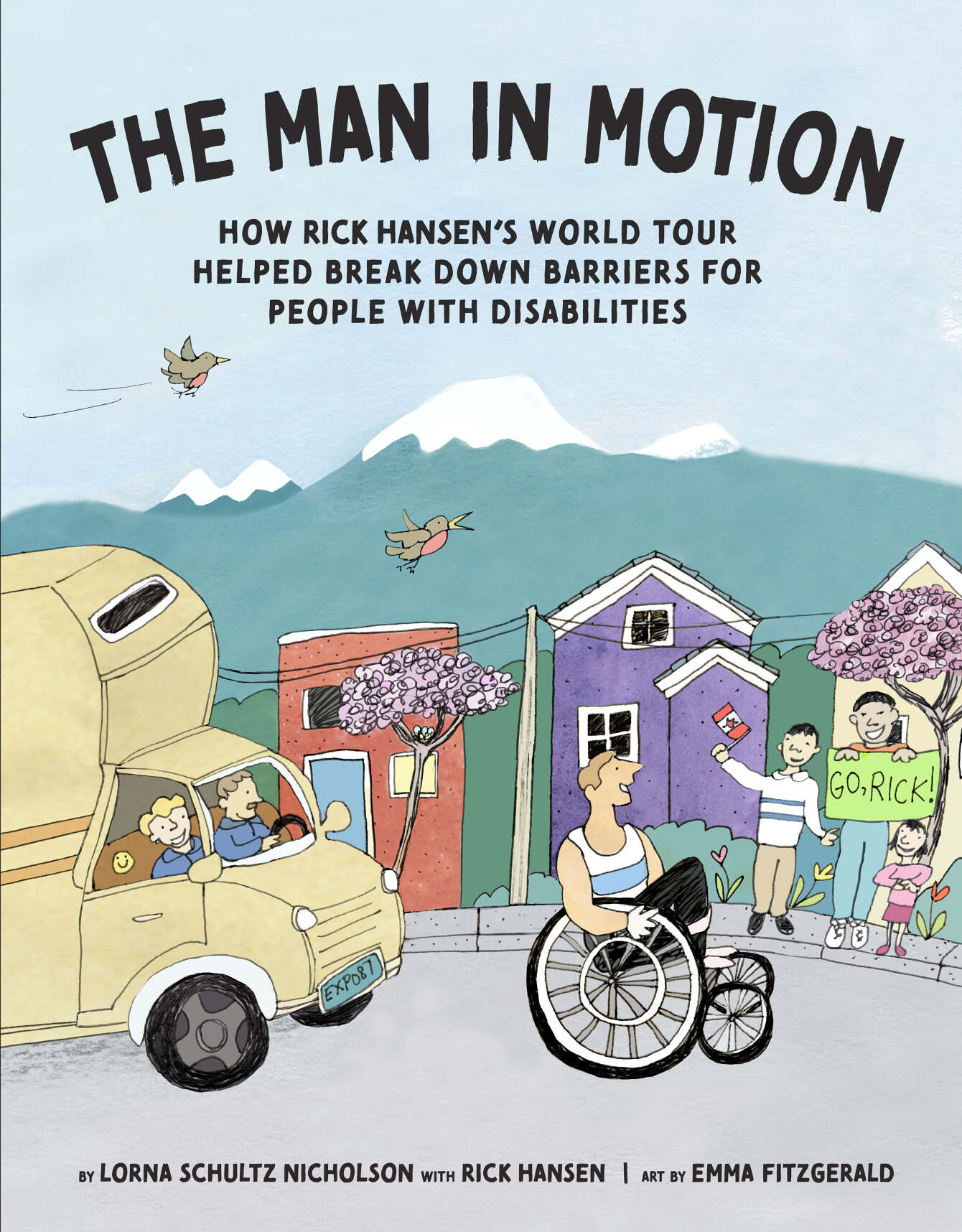
‘The Man In Motion: How Rick Hansen’s World Tour Helped Break Down Barriers For People With Disabilities’ can be purchased at your local bookstore or online.
The Man In Motion chocolate bar, featuring the book’s cover artwork, can be purchased at Kasama Chocolates at 1244 Cartwright St #2, Vancouver, BC V6H 3R8 or online. Partial proceeds from the sale of each chocolate bar go towards the Rick Hansen Foundation’s programs.