The Artist Who Drew Motion

Lunenburg is a pretty town on the south shore of Nova Scotia. Old buildings are painted in bursts of colour that line its harbour, fishing boats creak against the docks, and steep roads climb to a hilltop.
Somewhere on that hill that overlooks the waterfront is a tiny room in a derelict building where it leaks when it rains and bakes alive in the summer. It’s where the illustrations for the new Man In Motion children’s book came to life.
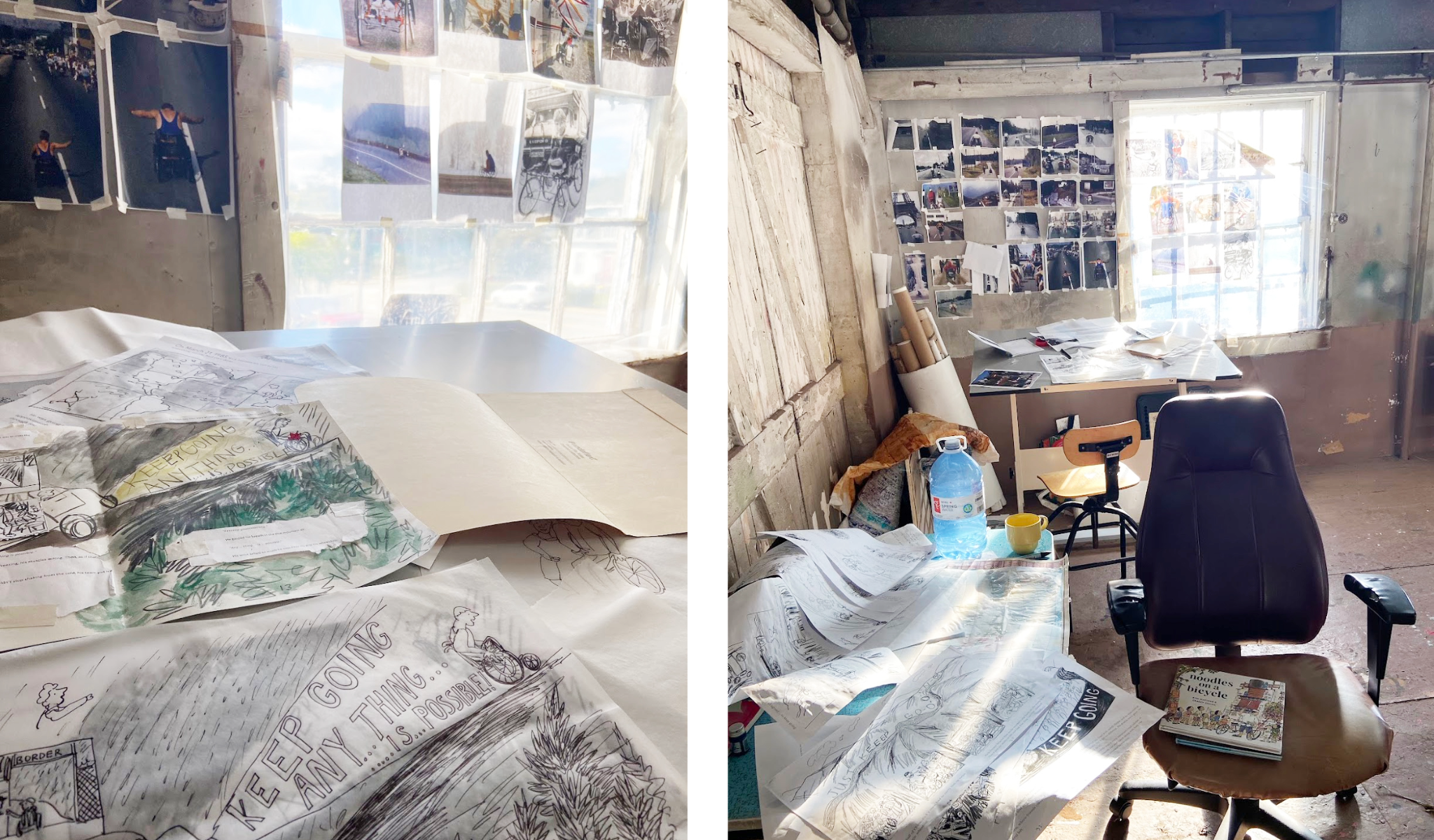
Emma Fitzgerald rented the space – her studio – for the sole purpose of immersion and being away from distraction at her house. She covered the wooden walls of the studio with photographs of Rick Hansen until the space looked less like an artist’s space than the bedroom of a boy band-obsessed teenage girl.
“Not just having the photos on my computer but physically around me was part of my process,” Emma said. “I have a folder for each spread in the book, an organizing system that I keep in a milk crate – just like a regular office folder. So that keeps me organized. It’s a bit rough, but it suits me.”
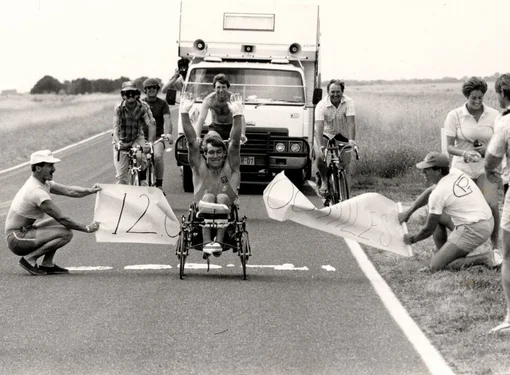
The photographs were organized in such a way that they showed moments from the Man In Motion World Tour in fragments: Rick slouched in exhaustion, Rick triumphant with his arms raised. A wide shot of Rick moving toward another impossible horizon. Emma even created a whole wall of just his back, because so much of the Tour was documented from that angle.
Style In Motion
The danger with heroes from bygone eras is that they calcify into school assemblies, commemorative plaques, and boring stories. But the Man In Motion World Tour was never a boring story. Forty thousand kilometres across 34 countries in a wheelchair, powered by sore shoulders, an unreasonable level of willpower, and a big dream. If that story is illustrated too neatly, it stops feeling real.
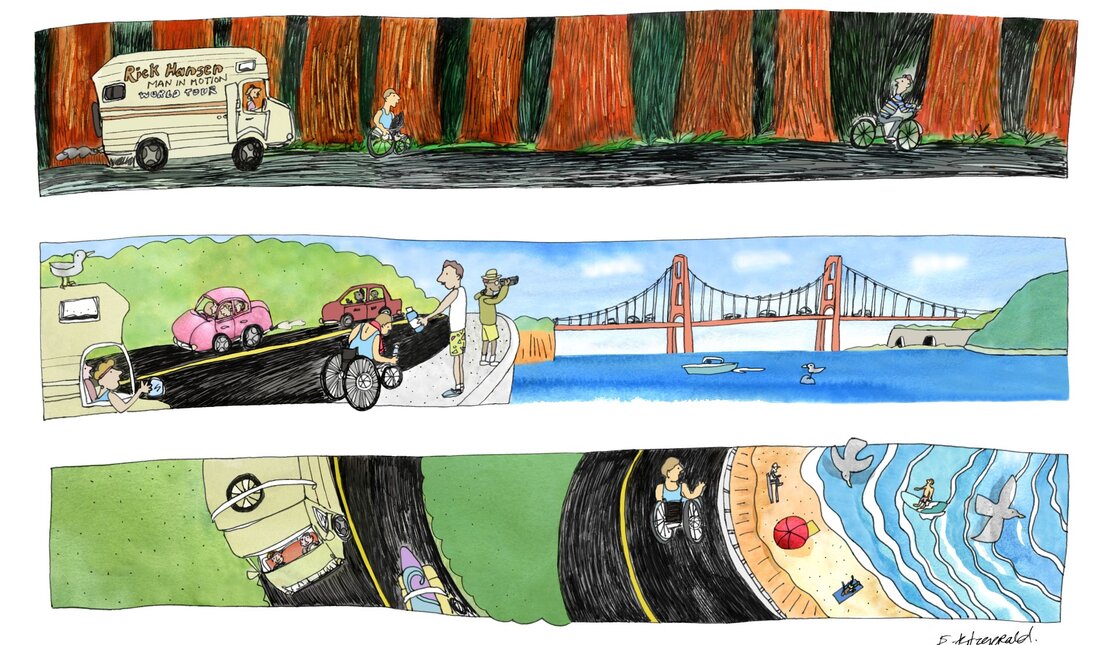
That’s why Emma was the perfect artist for ‘The Man In Motion: How Rick Hansen's World Tour Helped Break Down Barriers for People with Disabilities’ storybook by Lorna Schultz Nicholson. Her style carries the motion of loose lines that look like they were discovered in motion rather than carefully planned. Before this project, she illustrated ‘City Streets Are For People’, a transportation-focused book that wandered through cities and movement systems around the world. That book, she suspects, was her audition tape for ‘The Man In Motion’.
“I don't usually use pencil ahead of time,” Emma said of her process. “I just dive in with the pen and so therefore, I'm not really erasing. So, you kind of have to keep going, even if you make a mistake.”
That sentence could practically serve as the emotional thesis of the Man In Motion World World Tour itself.
In addition to raising awareness about the potential of people with disabilities, the need for more accessibility, and to raise money for spinal cord injury research, Rick’s journey 40 years ago was movement through injury, through bad weather, bureaucracies, exhaustion, and – at least initially – public obliviousness.

“That’s the style that developed for me over time. Part of it is because I traveled a lot in my teens and 20s,” Emma said. “My family had moved to Ireland from Vancouver when I was 16, then back again. And I lived in England and France in my 20s,” Emma recalled. “I was always wanting to draw but you only have so much time, so I developed this style of drawing which is a bit of a spontaneous process. I’m definitely more in the realm of celebrating the roughness versus doing something really polished.”
Emma avoids the trap of stagnation because she understands texture; physical texture, emotional texture, geographic texture. That includes cobblestones in Poland to the strange geometry of the Great Wall of China beneath wheels to heat rising off California pavement and the long horizontal of the Pacific Coast.
One of her favourite sequences in the book follows Rick through California: redwoods, cliffs, surfers, the long ache of coastal roads unfurling southward. She described the spreads almost like a traveller remembering a fever dream. “You feel some of the ecstasy of what it can feel like to be on an adventure.”
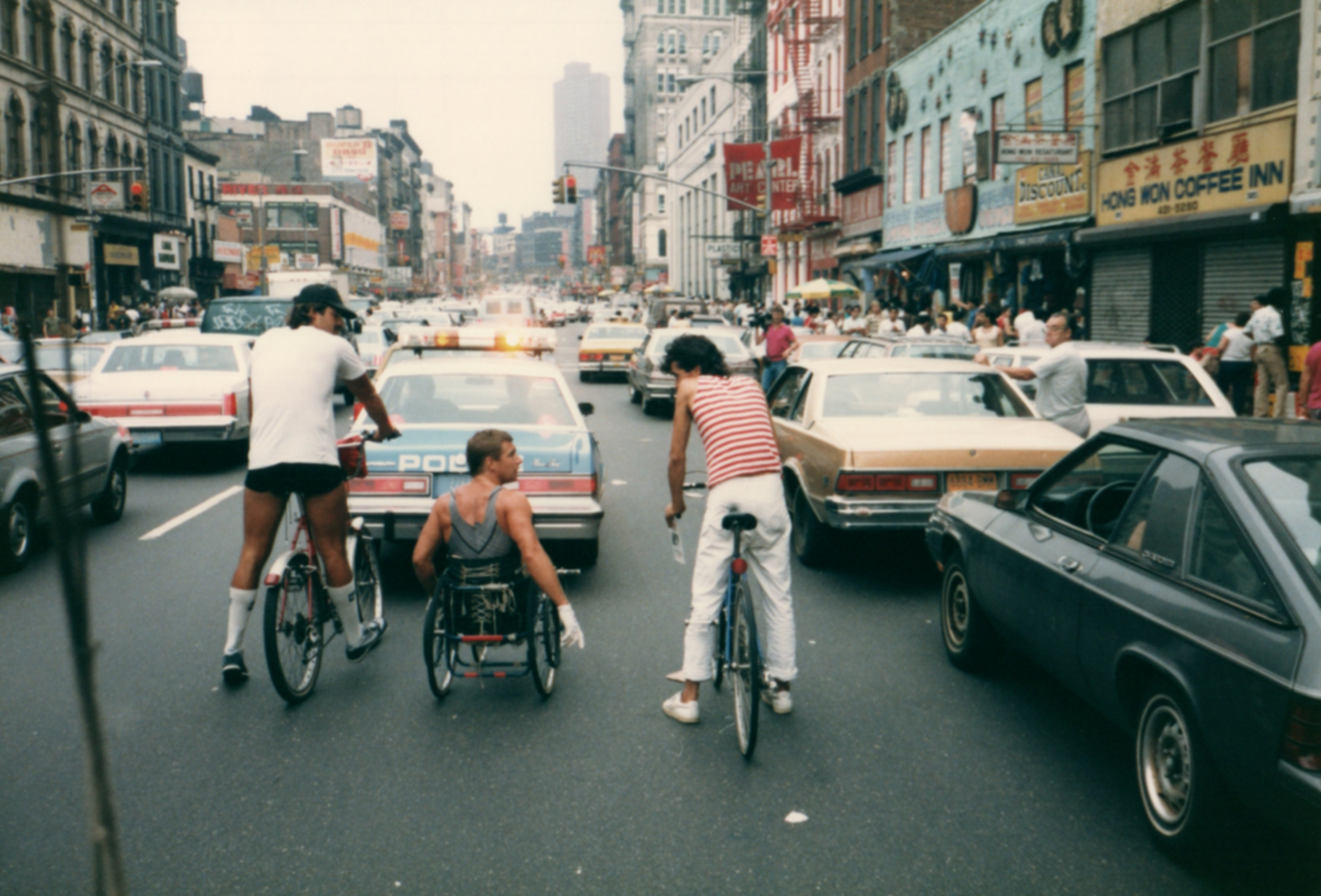
Before the Man In Motion World Tour became Canadian history, it was a marathon with many scrappy elements, with a man launching himself into the world with a small team, a dream, and no guarantee his body would survive the attempt at its centre. Emma seems instinctively drawn to that voltage.
Between the milk crates, walls papered with Tour photographs, long days working in a decrepit building by the sea – she received her eviction notice the day after moving in – her process echoed the spirit of the Tour itself. There’s nothing sleek or corporate about the artistry, which is perhaps why her finished work breathes.
The book’s illustrations range from giant cinematic spreads to tiny Polaroid-style snapshots meant to evoke the grainy visual culture of the 1980s, before everyone carried a smartphone camera in their pocket, before memory became frictionless. She even slipped additional narrative threads into the artwork itself, assigning phrases like “keep going” and moments of doubt to recurring animals hidden throughout the pages, little subconscious companions wandering beside Rick’s journey.
Children will notice them immediately. Adults, if they’re paying attention, will notice something else: the book understands that movement itself can become a language of emotion, history, and social change.

Filling in the Blanks
After the two-and-a-half years of living inside the orbit of the Man In Motion World Tour, Emma began the strange process of re-entry. The connective tissue started surfacing from her own life.
Longtime MuchMusic personality Terry David Mulligan’s son had been in her elementary school class in West Vancouver. It was Terry, in fact, who introduced Rick to David Foster, which led to the 1985 hit “St. Elmo’s Fire (Man in Motion).
Emma, who studied architecture at Dalhousie University before changing careers, had even helped design a Rick Hansen Foundation Accessibility Certified shelter for an urban garden. Before that project, she hadn’t even known much about the Tour itself. Her brother-in-law of Kasama Chocolate in Vancouver’s Granville Island, now sells a Man In Motion chocolate bar that features Emma’s cover of the Man In Motion book. The idea was a natural “yes!” from Emma as Kasama means friendship/togetherness in Tagalog – the language from the Philippines and the origin of many of Kasama’s cocoa beans.
This could be why the book doesn’t seem frozen in history; Emma chased the movement long enough for some of the momentum of the Man In Motion World Tour to find its way into her work.
‘The Man In Motion: How Rick Hansen’s World Tour Helped Break Down Barriers for People with Disabilities’ is available at your local bookstore and online retailers.
The Man In Motion chocolate bar can be purchased at Kasama Chocolates at 1244 Cartwright St #2, Vancouver, BC V6H 3R8 or online. Partial proceeds from the sale of each chocolate bar go towards the Rick Hansen Foundation’s programs.